
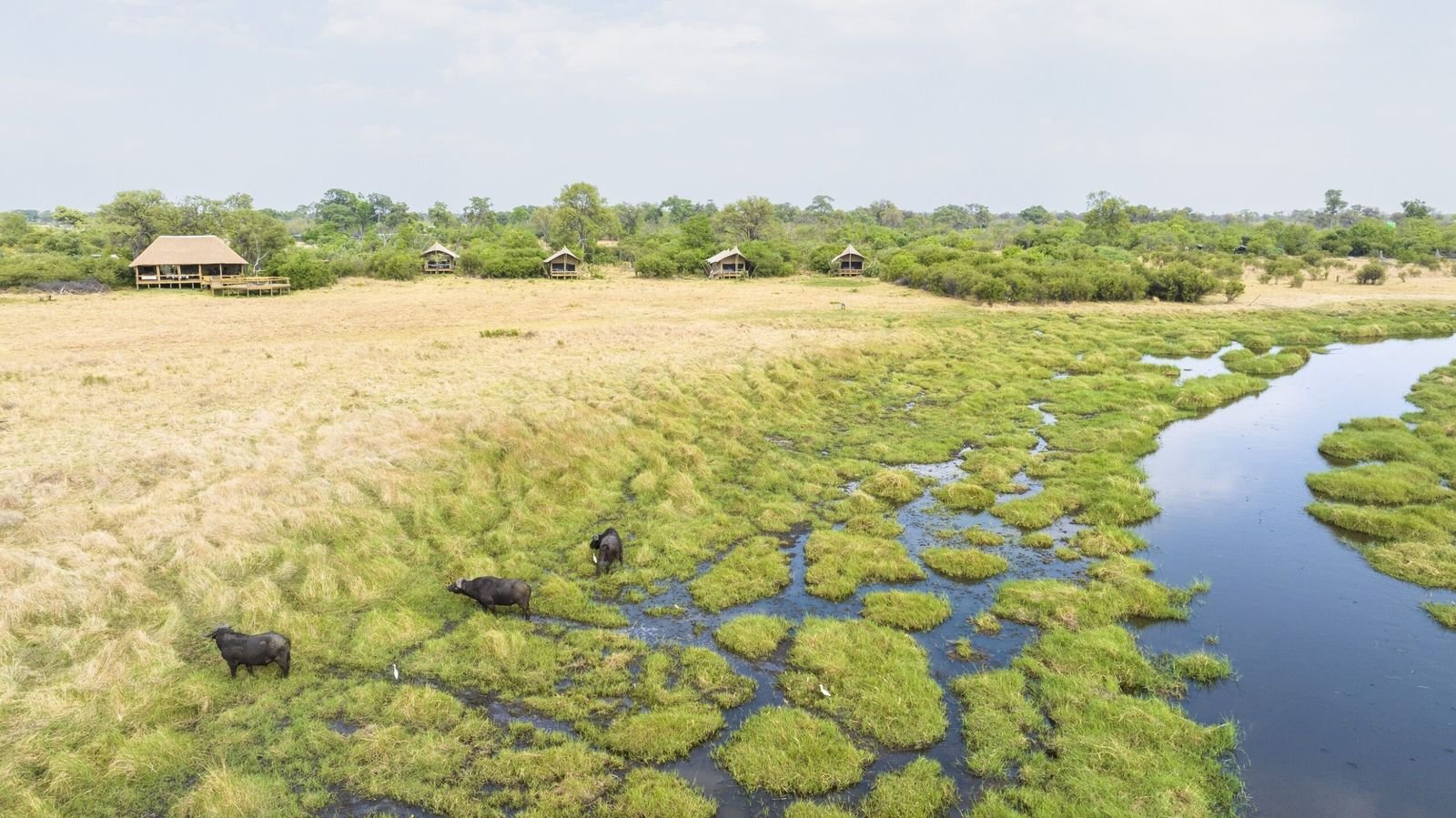
A Botswana safari is not one experience repeated across a map. It can mean drifting through reed-lined channels as a fish eagle calls above the Okavango Delta, tracking lion prints through Linyanti sand, or sitting beneath a vast salt-pan sky where the horizon seems to disappear.
The right journey is less about checking off parks than choosing the landscapes, pace, and style of guiding that will stay with you long after you return home.
Start With the Landscapes You Want to Feel
The Okavango Delta
The Delta is where safari days unfold by vehicle, on foot, and by mokoro, the traditional dugout canoe. Its channels rise and fall with the annual flood: one morning may bring red lechwe bounding through shallow water, the next buffalo moving between palm-fringed islands. It suits first-time visitors, but it is no gentle introduction. In the right area, predator viewing here is exceptional.
Linyanti and Chobe
Northern Botswana is elephant country. In the dry season, immense herds gather along the rivers. Linyanti feels secluded, with broad floodplains and unhurried time at sightings; Chobe offers spectacle along its riverfront, though its most accessible stretches can be busier. Many travelers pair the two.
The Makgadikgadi Pans and the Kalahari
Here the luxury is space: enormous skies, fossil lakebeds, and a silence that asks you to slow down. Black-maned lions on open plains, meerkats in early light, stars with no competing glow, and the privilege of being very small in a very old landscape.
Choose by Season, Not Just Calendar
From June to October, the dry season concentrates wildlife around water and the Delta flood is at its fullest, giving the most consistent game viewing of the year. From November to March, summer rains bring green landscapes, migratory birds, and new life, and transform the pans and the Kalahari. April and May sit between the two: cooler air, green country, and camps at their calmest. There is no perfect month, only the season that suits the story you want to bring home.
Camp Size Changes Everything
Luxury on safari is not marble or formality. It is waking because a lion has called nearby, and returning from a drive to a familiar face. A camp of 16 guests or fewer makes that possible: more personal service, more flexibility, and no sense of being processed through an itinerary. Ask how many guests share a vehicle, and whether a private one can be arranged.
Ask About the Guiding
A great guide does more than find animals. They read tracks in the dust, interpret alarm calls, and know when a sighting should be watched in silence rather than pursued. Botswana-based Safari Guides who have watched the flood arrive year after year offer more than identification. They offer context.
Ask, too, who owns the camps. Direct local ownership is not a decorative detail: it means decisions are made close to the ground, by people with a lasting stake in the wilderness. Untamed Places brings several of Botswana’s defining ecosystems together in one locally owned collection, making it easier to build a journey that feels connected rather than pieced together.
Leave Room for the Wild
The common mistake is trying to see everything at once. Allow at least three nights in each camp to settle in and let the unpredictable happen. Seven to ten nights creates a satisfying contrast: Delta water and Linyanti elephants, perhaps, or a northern circuit followed by the stillness of the pans. With more time, add a mobile safari, moving through the landscape with a small, supported camp for an uncommon closeness to the land.
Leave room for the unplanned morning: the leopard near camp, the herd that holds you by the river until sunset. Those are not interruptions to the itinerary. They are the reason to come.